


Who Was James Ross Snowden, the Director Who Invented the Mint’s Collector Business?
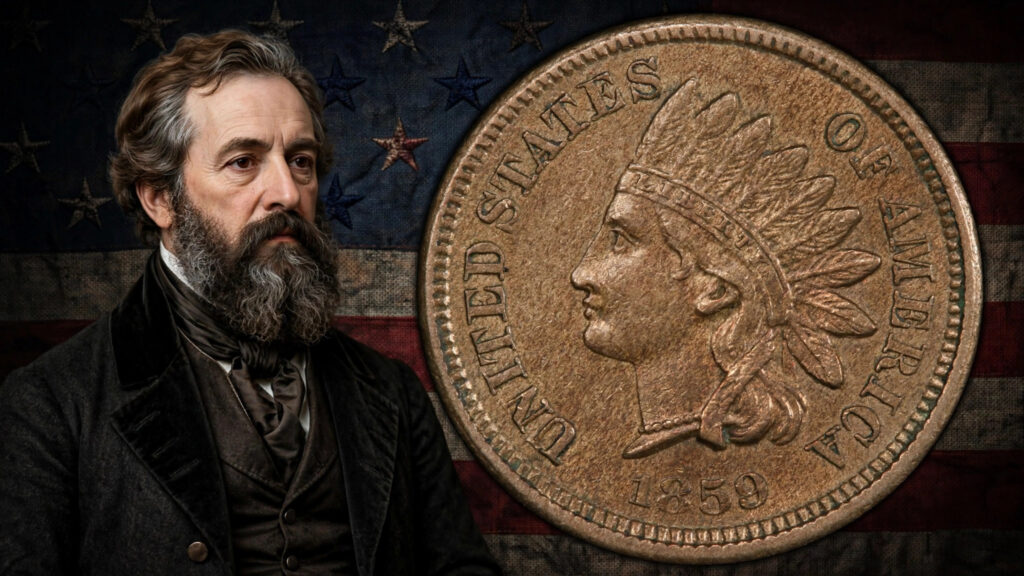
James Ross Snowden was Director of the United States Mint from June 1853 to May 1861, and the first director to treat collectors as a constituency of the Mint itself. A numismatist in office, he built up the Mint Cabinet — the national coin collection — catalogued it in print, and financed additions by selling or trading Mint-made patterns, restrikes and medals to collectors. He also directed the launch of the small Flying Eagle cent under the Coinage Act of February 21, 1857.
Key Takeaways
- Snowden had served as treasurer of the Mint (1847–1850) before becoming director in 1853.
- He published a catalogue of the Mint Cabinet in 1860 and a study of Washington medals in 1861.
- His January 1859 proposal to Treasury Secretary Howell Cobb asked to strike rarities at set prices, with profits benefiting the Mint Cabinet.
- The same era's unofficial restriking by Mint employees produced scandals that ended the program around 1860.
What was the Mint Cabinet, and why did Snowden champion it?
The Mint Cabinet was the United States' national collection of coins, medals and related objects, housed at the Philadelphia Mint, and Snowden championed it as a collection that should rival Europe's. PCGS's history of the Gobrecht dollars describes his "one overriding passion" as building the Cabinet, especially its holdings of Washington material. He published A Description of Ancient and Modern Coins in the Cabinet Collection at the Mint of the United States in 1860 and dedicated the Washington section of the Cabinet in a ceremony on February 22, 1860. The Cabinet's descendants survive today in the Smithsonian's National Numismatic Collection.
How did selling to collectors actually work under Snowden?
It worked, on Snowden's stated design, as an exchange system for the Cabinet's benefit. Collecting was booming in the late 1850s, and rare early American issues — Gobrecht dollars of 1836–1839, half cents of the 1840s, the 1827 quarter and the 1856 Flying Eagle cent — were in intense demand. Snowden restruck or struck such pieces and traded them to collectors for Washington tokens and medals the Cabinet lacked, or sold them and used the money to buy rarities. In a January 22, 1859 letter to Secretary Cobb, quoted in the standard histories, he proposed doing this openly: strike "some of each kind," affix a price, keep exact accounts, and let "the profits inure to the benefit of the Mint Cabinet." No reply from Cobb survives, and whether Snowden had formal approval remains unclear — a hedge the record requires.
| Snowden's stated program | The unofficial traffic | |
|---|---|---|
| Purpose | Build the Mint Cabinet | Private profit for employees |
| Method | Sell/trade patterns and restrikes at accounted prices | Clandestine striking and quiet sales |
| Beneficiary | The United States collection | Individual Mint insiders |
| Outcome | Washington holdings greatly enriched | Scandals; program stopped about 1860 |
Where did the collector business go wrong?
It went wrong when the line between official and private striking collapsed. PCGS's account notes that Snowden probably did not profit personally, but other Mint employees used Mint dies to strike rarities — most notoriously a small number of 1804 dollars around 1858–1860 — and pocketed the proceeds. Snowden bought back several of those pieces when he learned of them, but the publicity damaged the Mint. He sealed a group of sensitive dies in July 1860, and the open restrike trade ended. Modern retellings that blame Snowden personally for every clandestine strike go beyond what the standard histories support; that he created the permissive market, and at minimum looked the other way at times, is the more defensible charge. Collectors curious how pattern issues work can start with What Is a Pattern Set?
What was Snowden's role in the Flying Eagle cent?
Snowden was the administrative driver of the small cent from proposal to release. The large cent had become too expensive to produce, and in 1856 Snowden settled on a smaller cent of 88 percent copper and 12 percent nickel, recommending it to Treasury Secretary James Guthrie that July. He had Chief Engraver James B. Longacre prepare the Flying Eagle design — its eagle adapted from the Gobrecht dollar reverse — and struck hundreds of 1856-dated pattern cents, distributing at least 634 of them to congressmen, officials and President Franklin Pierce himself to build support. Congress passed the act on February 21, 1857, ending the large cent and the half cent and demonetizing foreign coins, and the new cents were released to long public lines on May 25, 1857. The 1856 Flying Eagle, technically a pattern, became one of America's most famous collectible cents precisely because Snowden had seeded it so widely.
Snowden proved collectors would queue at the Mint itself — the hobby he fed is the one Coin Advisor serves today. Browse silver coins at Coin Advisor, or call (877) 540-2646 to talk with a Preferred Collector Division advisor.
FAQ
When did James Ross Snowden direct the Mint? From June 1853 to May 1861, under Presidents Franklin Pierce and James Buchanan, succeeding Thomas M. Pettit and preceding James Pollock.
Did Snowden profit personally from restrikes? The standard PCGS history says he probably did not, and that his motive was building the Mint Cabinet. Other employees did profit, which caused the scandals.
Is the 1856 Flying Eagle cent a regular issue? No. It was a pattern struck before Congress authorized the new cent in February 1857, though Snowden distributed hundreds of examples and collectors have treated it as part of the series ever since.
What happened to the Mint Cabinet? It remained at the Mint into the twentieth century and ultimately became the core of the Smithsonian Institution's National Numismatic Collection.
This article was researched and drafted with AI assistance and reviewed and approved by Chris Clifton, Founder & CEO at Coin Advisor, before publication.
Shop NGC and PCGS certified coins at Coin Advisor
Shop Coins →Related Reading
Who Was David Rittenhouse, America’s First Mint Director?
David Rittenhouse was the first Director of the United States Mint, appointed by President George Washington in April 1792 and serving until June 1795. A leading astronomer, instrument maker and scientist, he built the Mint from nothing — hiring its officers, overseeing its first buildings in Philadelphia and launching copper coinage in 1793 and silver coinage in 1794. His tenure is also remembered for a controversial decision to strike the first silver coins finer than the law allowed.
Read More →
Who Was Elias Boudinot, the Director Who Steadied the Young Mint?
Elias Boudinot was the third Director of the United States Mint, serving from October 1795 to July 1805. A former president of the Continental Congress and a respected New Jersey statesman, he restored the legal silver standard on taking office, kept the chronically underfunded Mint operating — at times depositing his own bullion to keep workers employed — and halted production of silver dollars and gold eagles in 1804 because the large coins were being exported and melted rather than circulating at home.
Read More →
Who Was Robert Patterson, the Director Behind Seated Liberty?
Robert Maskell Patterson was Director of the United States Mint from 1835 to 1851 — the son of an earlier director also named Robert Patterson. Appointed by President Andrew Jackson, he drove the creation of Christian Gobrecht's Seated Liberty design, which spread across America's silver coinage beginning with the Gobrecht dollars of 1836 and the dime and half dime of 1837 and endured, in places, until 1891. He also resisted the gold dollar and double eagle authorized in 1849, and lost that fight to Congress.
Read More →