


Who Was Robert Patterson, the Director Behind Seated Liberty?
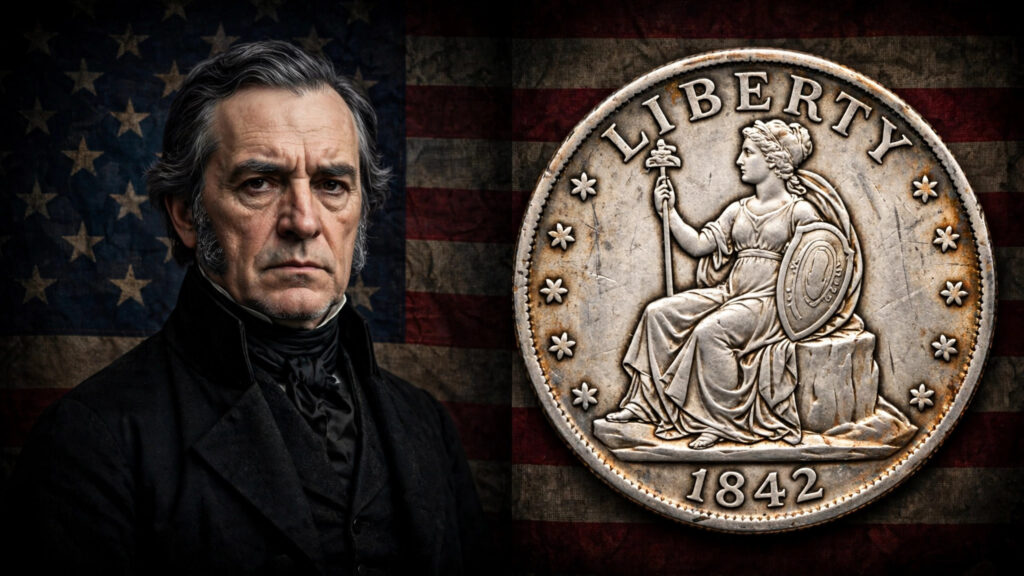
Robert Maskell Patterson was Director of the United States Mint from 1835 to 1851 — the son of an earlier director also named Robert Patterson. Appointed by President Andrew Jackson, he drove the creation of Christian Gobrecht's Seated Liberty design, which spread across America's silver coinage beginning with the Gobrecht dollars of 1836 and the dime and half dime of 1837 and endured, in places, until 1891. He also resisted the gold dollar and double eagle authorized in 1849, and lost that fight to Congress.
Key Takeaways
- There were two director Pattersons: Robert Patterson (1806–1824) and his son Robert Maskell Patterson (1835–1851). This post is about the son.
- Patterson conceived the seated figure, inspired by Britannia on British coinage, and commissioned artists Thomas Sully and Titian Peale.
- Engraver Christian Gobrecht translated the concept into dies; the design debuted on pattern dollars in 1836.
- Patterson opposed the tiny gold dollar for years; Congress authorized it and the double eagle over his objections on March 3, 1849.
Which Robert Patterson was he?
He was the son, and keeping the two men separate is essential to the Mint's early history.
| Robert Patterson (father) | Robert Maskell Patterson (son) | |
|---|---|---|
| Director | January 1806 – July 1824 | May/July 1835 – July 1851 |
| Appointed by | Thomas Jefferson | Andrew Jackson |
| Background | Professor, University of Pennsylvania | Physician and University of Pennsylvania professor |
| Signature legacy | Long, steady administration; Capped Bust era begins | Seated Liberty coinage; steam-powered coinage era |
Between them sat Samuel Moore (1824–1835), so the Pattersons did not serve consecutively. The younger Patterson, often written Robert M. Patterson, also worked between his father's tenure and his own directorship in Mint-related scientific roles, which helps explain why some older accounts blur the two careers.
How did Seated Liberty come from Patterson's desk?
Seated Liberty came from Patterson's desk because the concept, the artists and the instructions were his, even though the engraving was Gobrecht's. Patterson admired the seated Britannia on British copper and believed a seated female figure would be, in NGC's summary of his view, just as "emblematic of liberty" as the busts then in use. He had Chief Engraver William Kneass sketch the idea; after Kneass suffered a stroke in August 1835, Patterson recruited Christian Gobrecht as second engraver and commissioned portrait painter Thomas Sully and artist-naturalist Titian Peale to refine the drawing. Gobrecht then adapted Sully's sketches to coin relief.
Where did the design appear, and how long did it last?
The design appeared first on the silver dollars of 1836 now called Gobrecht dollars, then spread denomination by denomination. The dime and half dime adopted it in 1837, the quarter in 1838, the half dollar in 1839 and a redesigned, regularly issued dollar in 1840. Modified by later engravers — notably Robert Ball Hughes's 1840 reworking and James B. Longacre's later revisions — Seated Liberty remained the standard obverse for most American silver coins for more than fifty years, with the last Seated Liberty dimes, quarters and half dollars dated 1891. NGC calls the result a design used, at one time or another, on every silver denomination from the half dime through the dollar, plus the later twenty-cent piece.
Why did Patterson fight the gold dollar — and lose?
Patterson fought the gold dollar mainly because he believed a gold coin only about a half-inch across was impractical, and he said so to Congress for years. A gold dollar had been proposed in the 1830s; Treasury Secretary Levi Woodbury favored it, Patterson opposed it, and after Patterson testified, an authorization provision was dropped. He repeated his objections in 1844 when Representative James Iver McKay revived the idea. What changed the outcome was California: gold discoveries in 1848 flooded the Mint with bullion and made both a small gold coin and a large one politically irresistible. On his last day in office, March 3, 1849, President James K. Polk signed the act authorizing the gold dollar and the $20 double eagle. Patterson's reply on the double eagle had actually been mild — that there was "no other objection" except that it was "not needed" — but Pennsylvania Representative Joseph Ingersoll told the House the director opposed both new denominations, and Congress passed them by large margins anyway.
Seated Liberty silver and the first double eagles both trace back to Patterson's Mint — one his triumph, one his defeat. Browse silver coins and gold coins at Coin Advisor, or call (877) 540-2646 to talk with a Preferred Collector Division advisor.
FAQ
Was Robert Maskell Patterson related to the earlier director Robert Patterson? Yes. He was his son. The father directed the Mint from 1806 to 1824; the son directed it from 1835 to 1851.
Who actually engraved Seated Liberty? Christian Gobrecht, working from Thomas Sully's sketches of Patterson's seated-figure concept. Patterson directed the project; Gobrecht made it coinable.
What was the Gobrecht dollar? A dollar bearing the new Seated Liberty obverse and a flying eagle reverse, struck in small numbers from 1836 to 1839 before the regular Seated Liberty dollar began in 1840.
Did Patterson stop the gold dollar permanently? No. He delayed it through the 1830s and 1840s, but Congress authorized the gold dollar and double eagle on March 3, 1849, over his objections.
This article was researched and drafted with AI assistance and reviewed and approved by [Author], [Role] at Coin Advisor, before publication.
Shop NGC and PCGS certified coins at Coin Advisor
Shop Coins →Related Reading
Who Was James Ross Snowden, the Director Who Invented the Mint’s Collector Business?
James Ross Snowden was Director of the United States Mint from June 1853 to May 1861, and the first director to treat collectors as a constituency of the Mint itself. A numismatist in office, he built up the Mint Cabinet — the national coin collection — catalogued it in print, and financed additions by selling or trading Mint-made patterns, restrikes and medals to collectors. He also directed the launch of the small Flying Eagle cent under the Coinage Act of February 21, 1857.
Read More →
Who Was David Rittenhouse, America’s First Mint Director?
David Rittenhouse was the first Director of the United States Mint, appointed by President George Washington in April 1792 and serving until June 1795. A leading astronomer, instrument maker and scientist, he built the Mint from nothing — hiring its officers, overseeing its first buildings in Philadelphia and launching copper coinage in 1793 and silver coinage in 1794. His tenure is also remembered for a controversial decision to strike the first silver coins finer than the law allowed.
Read More →
Who Was Elias Boudinot, the Director Who Steadied the Young Mint?
Elias Boudinot was the third Director of the United States Mint, serving from October 1795 to July 1805. A former president of the Continental Congress and a respected New Jersey statesman, he restored the legal silver standard on taking office, kept the chronically underfunded Mint operating — at times depositing his own bullion to keep workers employed — and halted production of silver dollars and gold eagles in 1804 because the large coins were being exported and melted rather than circulating at home.
Read More →