


Who Was Elias Boudinot, the Director Who Steadied the Young Mint?
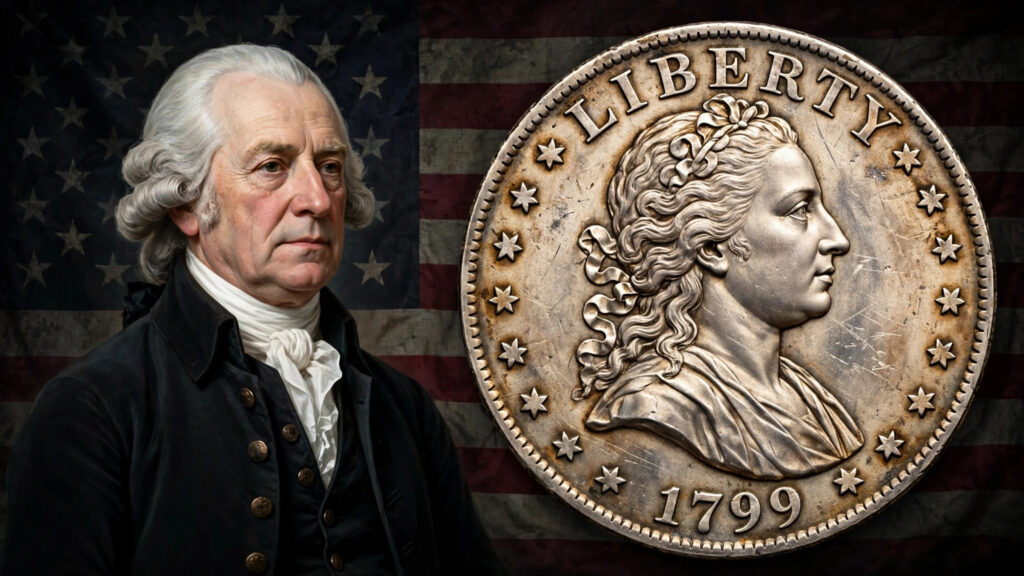
Elias Boudinot was the third Director of the United States Mint, serving from October 1795 to July 1805. A former president of the Continental Congress and a respected New Jersey statesman, he restored the legal silver standard on taking office, kept the chronically underfunded Mint operating — at times depositing his own bullion to keep workers employed — and halted production of silver dollars and gold eagles in 1804 because the large coins were being exported and melted rather than circulating at home.
Key Takeaways
- Boudinot took office October 28, 1795, and immediately ordered silver struck at the legal .8924 fineness.
- He repeatedly defended the Mint's funding and existence before Congress and the administration.
- From 1801 he steered depositors toward half dollars instead of dollars to slow the export drain.
- Dollar coinage bearing dates through 1803 was delivered into early 1804, then stopped — the gap that later produced the famous 1804 dollar.
What did Boudinot fix first?
Boudinot first fixed the silver standard, ordering on taking office that coinage return to the .8924 fineness Congress had set in 1792. His brief predecessor, Henry William De Saussure, had continued the unauthorized .900 fineness approved under Rittenhouse, which overpaid in silver on every coin and short-changed depositors. Restoring the legal standard was both a financial correction and a credibility repair for an institution barely three years old, at a moment when public knowledge of the episode threatened trust in federal coinage.
How did he keep a fragile Mint alive?
He kept the Mint alive by using his standing, his reports and, when necessary, his own money. Boudinot had presided over the Continental Congress and served in the U.S. House, and he argued the Mint's case to Congress in annual reports that documented its work and needs. CoinWeek's survey of notable directors notes that when bullion deposits slowed, Boudinot deposited his own bullion to keep Mint employees working. That combination — political access, persistent advocacy and personal deposits — steadied an operation that depended on depositors choosing to bring metal to Philadelphia at all.
Why did he want dollar and eagle coinage stopped?
He wanted them stopped because the largest American coins were leaving the country instead of circulating. Boudinot complained as early as his 1799 report that U.S. gold and silver coins were being melted by goldsmiths and, as PCGS's history of 1804 summarizes, large silver dollars and $10 gold eagles were profitably exported as bullion by speculators. A dollar shipped abroad did the young economy no work at home. His remedy was substitution: beginning in 1801 he persuaded depositors to accept half dollars, which were less attractive for export, and filled the silver coinage with that denomination instead.
| Denomination | Boudinot-era outcome | Reason |
|---|---|---|
| Silver dollar | Deliveries ended in early 1804; no regular issue again for decades | Exported and melted as bullion |
| Gold eagle ($10) | Last struck in 1804; not resumed until 1838 | Same export drain |
| Half dollar | Coinage greatly expanded from 1801 | Stayed in domestic circulation |
The halt itself needs precise wording. The last dollars delivered, in the first quarter of 1804, bore the date 1803; production stopped in March 1804, during Boudinot's tenure and at his direction, as the standard histories put it. The policy was formalized after he left: a May 1, 1806 letter from Secretary of State James Madison to Boudinot's successor, Robert Patterson, recorded President Jefferson's instruction that silver be coined only in small denominations, and a formal suspension followed a request from the Bank of the United States. Attributing a signed 1804 presidential order to Boudinot alone would overstate the surviving paper trail.
How did that halt create the 1804 dollar legend?
It created the legend because the Mint's own records later misled the Mint itself. When, in 1834, the State Department wanted complete proof sets as diplomatic gifts for Asian rulers, Mint officials read delivery figures for 1804 and assumed dollars dated 1804 had been struck. They therefore struck dollars dated 1804 — coins that had never existed as regular issues. Those presentation pieces, and later restrikes, became the celebrated 1804 dollar, the "King of American Coins." Without Boudinot's export-driven halt, there would have been ordinary 1804 dollars, and no rarity to rediscover.
The half dollars Boudinot championed carried American commerce for decades after the dollar went on hiatus. Browse silver coins at Coin Advisor, or call (877) 540-2646 to talk with a Preferred Collector Division advisor.
FAQ
When did Elias Boudinot direct the Mint? From October 1795 to July 1805, succeeding the short-tenured Henry William De Saussure and preceding Robert Patterson.
Were any dollars actually dated 1804 struck in 1804? No. The last regular deliveries, in early 1804, were dated 1803. The famous 1804-dated dollars were struck in 1834 and later for presentation sets and collectors.
Why were half dollars the substitute? Half dollars were less profitable to export as bullion, so they tended to remain in domestic circulation, which was Boudinot's goal.
When did silver dollar coinage resume? Only in a limited way in the later 1830s, with the Gobrecht dollar issues, and for regular production with the Seated Liberty dollar in 1840.
This article was researched and drafted with AI assistance and reviewed and approved by Chris Clifton, Founder & CEO at Coin Advisor, before publication.
Shop NGC and PCGS certified coins at Coin Advisor
Shop Coins →Related Reading
Who Was David Rittenhouse, America’s First Mint Director?
David Rittenhouse was the first Director of the United States Mint, appointed by President George Washington in April 1792 and serving until June 1795. A leading astronomer, instrument maker and scientist, he built the Mint from nothing — hiring its officers, overseeing its first buildings in Philadelphia and launching copper coinage in 1793 and silver coinage in 1794. His tenure is also remembered for a controversial decision to strike the first silver coins finer than the law allowed.
Read More →
Who Was Robert Patterson, the Director Behind Seated Liberty?
Robert Maskell Patterson was Director of the United States Mint from 1835 to 1851 — the son of an earlier director also named Robert Patterson. Appointed by President Andrew Jackson, he drove the creation of Christian Gobrecht's Seated Liberty design, which spread across America's silver coinage beginning with the Gobrecht dollars of 1836 and the dime and half dime of 1837 and endured, in places, until 1891. He also resisted the gold dollar and double eagle authorized in 1849, and lost that fight to Congress.
Read More →
Who Was James Ross Snowden, the Director Who Invented the Mint’s Collector Business?
James Ross Snowden was Director of the United States Mint from June 1853 to May 1861, and the first director to treat collectors as a constituency of the Mint itself. A numismatist in office, he built up the Mint Cabinet — the national coin collection — catalogued it in print, and financed additions by selling or trading Mint-made patterns, restrikes and medals to collectors. He also directed the launch of the small Flying Eagle cent under the Coinage Act of February 21, 1857.
Read More →