


How Did Richard Nixon End the Dollar’s Last Link to Gold?
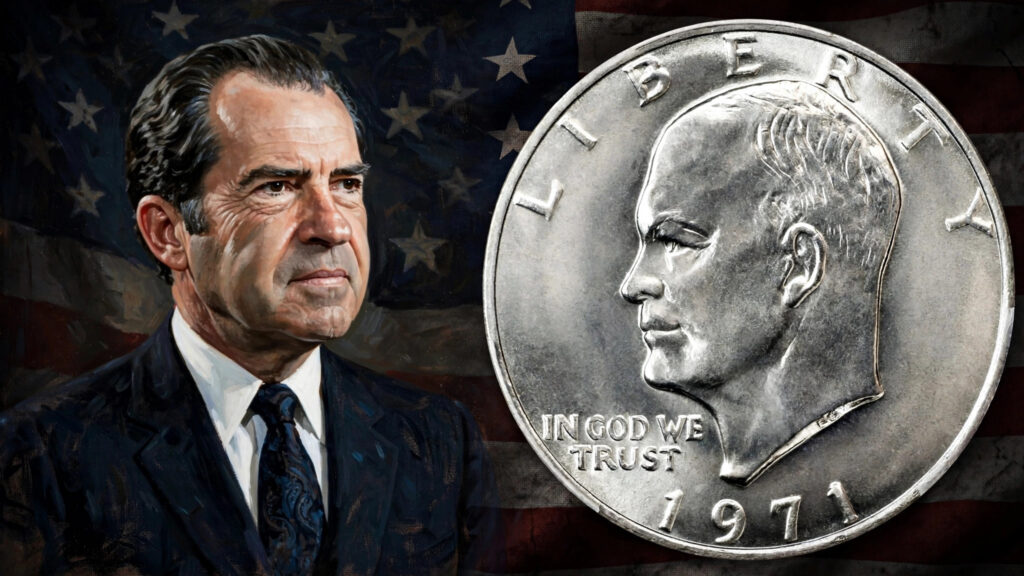
Richard Nixon ended the dollar's last link to gold personally, on live television, on August 15, 1971, when he announced that the United States would stop converting dollars into gold for foreign governments — closing the "gold window" that had anchored the world monetary system since 1944. The same president also signed the law that created the Eisenhower dollar and removed the last silver from the half dollar, and the act that put Bicentennial designs on the quarter, half dollar, and dollar.
Key Takeaways
- On August 15, 1971, Nixon announced a "temporary" suspension of dollar convertibility into gold; the suspension was never reversed, and the Bretton Woods system ended with it.
- On December 31, 1970 — minutes before a pocket-veto deadline — Nixon signed the law authorizing the Eisenhower dollar: clad for circulation, 40% silver for collectors.
- That same 1970 law removed the last silver from the Kennedy half dollar, ending silver in circulating U.S. coinage.
- On October 18, 1973, Nixon signed the Bicentennial coinage act, authorizing the dual-dated 1776–1976 quarter, half dollar, and dollar.
What did Nixon announce on August 15, 1971?
Nixon announced that the dollar would no longer be convertible into gold, directing Treasury Secretary John Connally to suspend convertibility except where it served U.S. interests. Under the Bretton Woods agreement of 1944, foreign governments and central banks could present dollars to the U.S. Treasury and receive gold at $35 an ounce. By 1971, dollars held abroad far exceeded the gold in American vaults, and foreign treasuries had begun asking for metal. After a weekend of deliberations at Camp David, Nixon went on television on a Sunday evening — with markets closed — and presented the suspension as one part of a broader economic program that also included a wage-and-price freeze. He described the gold measure as temporary. It was not: the window never reopened, exchange rates floated, and for the first time the dollar rested on government credit alone.
Why does the gold window matter to coin collectors?
It matters because August 1971 is the dividing line between money backed by metal and money backed by trust — the backdrop for every coin a modern collector holds. The silver had already left the coinage in the 1960s, but gold convertibility was the last formal promise tying the dollar to a precious metal at a fixed rate. Once that promise ended, gold's price was free to move, and over the following decade it rose from $35 an ounce to levels that transformed pre-1933 U.S. gold coins, and later the American Eagle bullion program, into hard-asset holdings rather than pocket change. Collectors who divide their cabinets into "before" and "after" eras are, knowingly or not, using Nixon's announcement as the hinge. The coins did not change that Sunday night; what a dollar was changed permanently.
What coin did Nixon's signature create on December 31, 1970?
It created the Eisenhower dollar, the first dollar coin struck since the Peace dollar series ended in 1935. Congress had spent 1970 arguing over silver: the compromise bill authorized a copper-nickel clad dollar for circulation and up to 150 million dollars in 40% silver, sold to collectors at a premium. Nixon, who had served as Eisenhower's vice president, signed the bill on December 31, 1970, only minutes before it would have died by pocket veto. The same law quietly finished another era by removing the remaining 40% silver from the Kennedy half dollar, making the half fully clad from 1971 onward. Chief Engraver Frank Gasparro designed the new dollar, pairing Eisenhower's portrait with an eagle landing on the Moon in honor of Apollo 11. The big clad dollar never circulated widely, but its 40% silver editions remain a collector staple.
What did the Bicentennial coinage act do?
The act Nixon signed on October 18, 1973 authorized a one-time redesign of the quarter, half dollar, and dollar for the nation's 200th birthday. Instead of ordinary reverses, the three coins received Bicentennial designs — a colonial drummer on the quarter, Independence Hall on the half dollar, and the Liberty Bell against the Moon on the dollar — and all carried the dual date 1776–1976. The coins were struck across 1975 and 1976, which is why no quarters, halves, or dollars dated 1975 exist. It was the first time since the 1890s that multiple circulating denominations were redesigned together for a national celebration, and it proved that Americans would watch their pocket change for new designs — a lesson the Mint applied a generation later with the 50 State Quarters. For Nixon, who resigned in August 1974, the Bicentennial coins are the most cheerful survivors of his presidency.
Collecting the coins Nixon's story produced — Eisenhower dollars, Bicentennial issues, and the gold that outlasted the gold window? Browse silver coins and gold coins at Coin Advisor, or call (877) 540-2646 to talk with a Preferred Collector Division advisor.
FAQ
When did Nixon close the gold window? On August 15, 1971, in a televised address announcing his new economic program. He directed the Treasury to suspend converting dollars into gold for foreign governments, a "temporary" step that was never reversed.
Could ordinary Americans redeem dollars for gold before 1971? No. Private gold redemption had ended in the 1930s under Franklin D. Roosevelt. The convertibility Nixon ended applied to foreign governments and central banks under the Bretton Woods system, at $35 an ounce.
Did Nixon create the Eisenhower dollar? Congress authorized it, but Nixon's signature made it law on December 31, 1970, minutes before a pocket-veto deadline. The law issued the dollar in clad for circulation and 40% silver for collectors, and removed the last silver from the half dollar.
Why are there no 1975 quarters? The Bicentennial coins authorized in 1973 were struck during both 1975 and 1976, and every quarter, half dollar, and dollar in the program carried the dual date 1776–1976, so none bears a 1975 date.
This article was researched and drafted with AI assistance and reviewed and approved by Chris Clifton, Founder & CEO at Coin Advisor, before publication.
Shop NGC and PCGS certified coins at Coin Advisor
Shop Coins →Related Reading
Who Was William M. Stewart, the Senator Who Branded 1873 a Crime?
William Morris Stewart (1827–1909) was Nevada's first senator, the mining lawyer known as the "Father of the Mining Laws of the United States" for the federal mining statutes of 1866 and 1872. His place in coin history is stranger. Stewart was in the Senate in 1873 and voted for the Coinage Act that ended the silver dollar — and then, after silver's price collapsed, he returned to the Senate in 1887 and spent eighteen years denouncing that act as the "Crime of '73," claiming its passage had been a deception. The voting record is the honest footnote to his legend: the man who made "crime" the act's permanent name had been one of its supporters.
Read More →
What Was the ‘Crime of ’73’ That Ulysses S. Grant Signed?
The "Crime of '73" is the bitter name silver interests gave the Coinage Act of February 12, 1873, which Ulysses S. Grant signed as a routine Mint housekeeping bill. Buried in its revision of the mint laws was one quiet omission: the standard silver dollar no longer appeared on the list of authorized coins, ending the free coinage of silver in the United States. The same act created the Trade dollar, abolished the two-cent piece, three-cent silver, and half dime, and slightly raised the weight of the remaining silver coins. Almost nobody noticed at the time — the explosion came three years later.
Read More →
How Did Grover Cleveland’s Silver Repeal Create the Key-Date Morgans?
Grover Cleveland did not merely sign a coinage law — he forced one through. When the Panic of 1893 drained the Treasury's gold reserve below its symbolic $100 million floor, on April 22, 1893, Cleveland called Congress into special session for the single purpose of repealing the Sherman Silver Purchase Act, demanded repeal with no free-silver substitute, and pressured his own party's senators until he could sign the repeal on November 1, 1893. With the government no longer required to buy silver and coin it into dollars, Morgan dollar production collapsed — and the tiny mintages of 1893–95 became the key dates collectors chase today.
Read More →