


How Did Franklin D. Roosevelt End America’s Gold Coinage?
Franklin D. Roosevelt ended America's gold coinage in less than a year. On April 5, 1933, barely a month into his presidency, he signed Executive Order 6102, which required Americans to turn in their gold coins, bullion, and gold certificates to the government. The Gold Reserve Act of January 1934 then made the change permanent, ended gold coinage for good, and raised the official price of gold from $20.67 to $35 an ounce. Gold coins had circulated in the United States since the 1790s; after Roosevelt, they never circulated again.
Key Takeaways
- Executive Order 6102 (April 5, 1933) required Americans to deliver gold coin, bullion, and certificates to a Federal Reserve Bank by May 1, 1933, paid at $20.67 per troy ounce, under penalty of up to a $10,000 fine or ten years in prison.
- The order carried narrow exemptions — up to $100 in gold coin per person, gold for industrial and artistic use, and coins with recognized special value to collectors — a carve-out that quietly protected the coin hobby.
- The Gold Reserve Act (January 30, 1934) transferred all Federal Reserve gold to the Treasury, ended gold coinage, and let Roosevelt reset gold to $35 an ounce — a devaluation of over 40 percent, with the roughly $2.8 billion revaluation profit going to the Treasury.
- The 1933 Saint-Gaudens double eagle was struck but never issued; nearly all 445,500 coins were melted. The single example legal to own sold for $18.9 million in 2021, making it the world's most valuable coin.
What did Executive Order 6102 require?
Executive Order 6102, signed April 5, 1933, forbade "the hoarding of gold coin, gold bullion, and gold certificates" and required every person in the United States to deliver theirs to a Federal Reserve Bank or member bank on or before May 1, 1933. Holders were paid $20.67 per troy ounce — the statutory price of gold since the Gold Standard Act of 1900 — in paper currency. Willful violation carried a fine of up to $10,000, up to ten years in prison, or both. Roosevelt acted just weeks after taking office, in the depths of the banking crisis, using authority drawn from the Trading with the Enemy Act of 1917 as amended by the Emergency Banking Act that March. The exemptions mattered to collectors: the order allowed each person to keep up to $100 in gold coin (five $20 double eagles) and specifically spared gold coins of recognized special value to collectors of rare and unusual coins. Even so, enforcement and social pressure pulled enormous quantities of gold coin out of private hands — and most of what came in was melted into bars.
How did the Gold Reserve Act make it permanent?
The Gold Reserve Act, signed January 30, 1934, turned an emergency order into permanent law. It transferred title to all gold coin and bullion held by the Federal Reserve Banks to the U.S. Treasury, ended the coinage of gold entirely, and authorized the President to fix the gold content of the dollar at between 50 and 60 percent of its former weight. Roosevelt acted the next day, proclaiming gold at $35 an ounce — so the government that had bought the nation's gold at $20.67 an ounce nine months earlier now held metal officially worth about 69 percent more, a revaluation profit of roughly $2.8 billion that belonged to the Treasury. Ordinary Americans would not legally own gold bullion again until the end of 1974.
| Before 1933 | After the Gold Reserve Act (1934) | |
|---|---|---|
| Gold coins in circulation | Yes — eagles and double eagles spent since the 1790s | None; gold coinage ended |
| Official price of gold | $20.67 per troy ounce | $35 per troy ounce |
| Private gold ownership | Legal | Prohibited (narrow exemptions only) |
| Where the nation's gold sat | Federal Reserve Banks and private hands | U.S. Treasury |
What happened to the 1933 double eagles?
The 1933 double eagle is the most famous casualty of Roosevelt's gold policy. The Philadelphia Mint struck 445,500 of Augustus Saint-Gaudens' $20 gold pieces that spring — but because of the recall, none were ever officially issued or paid out. The entire mintage was ordered melted, and all but two pieces (saved for the national collection, now at the Smithsonian) were destroyed. A small number escaped the Mint anyway and passed into collectors' hands; the government has spent decades recovering them, maintaining that any example outside its own holdings is stolen property. Exactly one coin — once owned by King Farouk of Egypt, exported in 1944 under a license issued in error — was legalized under a settlement and may be privately owned. That coin sold for $7.59 million in 2002 and again at Sotheby's in June 2021 for $18,872,250, the highest price ever paid for a coin. Roosevelt never intended to create the world's most valuable coin — but by making the 1933 double eagle forbidden, his gold recall did exactly that.
Why is Roosevelt on the dime?
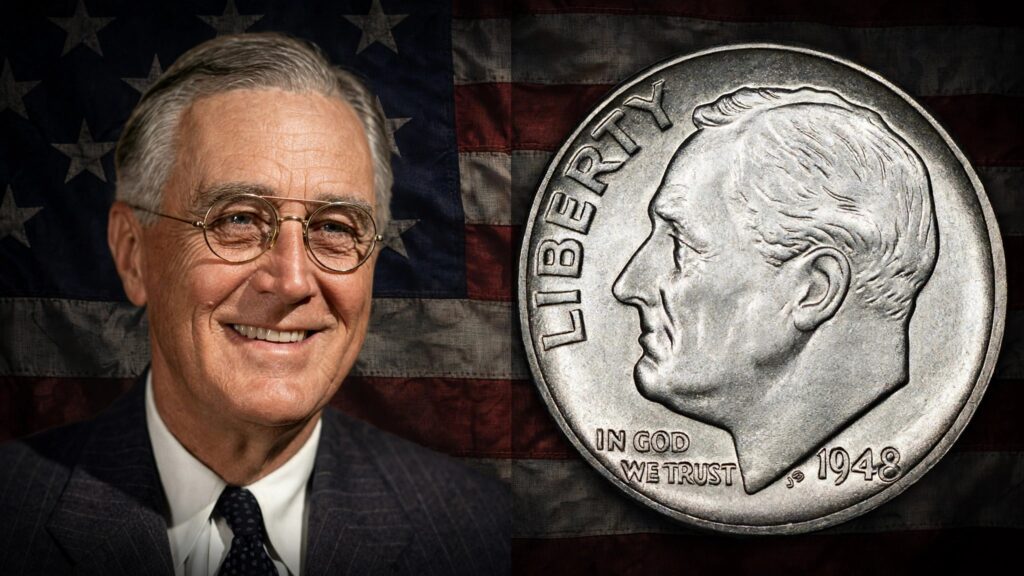
The Roosevelt dime is a tribute, not part of Roosevelt's own coinage policy — it appeared after his death. Roosevelt died on April 12, 1945, and because he had founded the National Foundation for Infantile Paralysis, whose annual fundraiser was the March of Dimes, the dime was the natural coin to honor him. Chief Engraver John R. Sinnock designed the new dime, and it was released on January 30, 1946 — Roosevelt's birthday, timed to the March of Dimes campaign. Sinnock's portrait is still on the dime today. It is a fitting footnote: the president who removed gold from American pockets is now the face of one of the most familiar coins in them.
FAQ
When did the United States stop making gold coins? 1933 was the last year of U.S. gold coinage for circulation. Executive Order 6102 recalled gold coins that April, and the Gold Reserve Act of January 1934 ended gold coinage permanently.
Were collectors forced to surrender rare coins? No. Executive Order 6102 exempted gold coins with "a recognized special value to collectors of rare and unusual coins," along with up to $100 in gold coin per person — though many ordinary gold coins were turned in and melted.
Can you legally own a 1933 double eagle? Only one example — the coin once owned by King Farouk, legalized under a government settlement — may be privately owned. Every other surviving 1933 double eagle is claimed by the U.S. government as its property.
When could Americans own gold again? Not until December 31, 1974, when legislation signed by President Gerald Ford restored the right of private citizens to own gold bullion and coins.
Shop American gold coins at Coin Advisor or call (877) 540-2646.
This article was researched and drafted with AI assistance and reviewed and approved by Chris Clifton, Founder & CEO at Coin Advisor, before publication.
Shop NGC and PCGS certified coins at Coin Advisor
Shop Coins →Related Reading
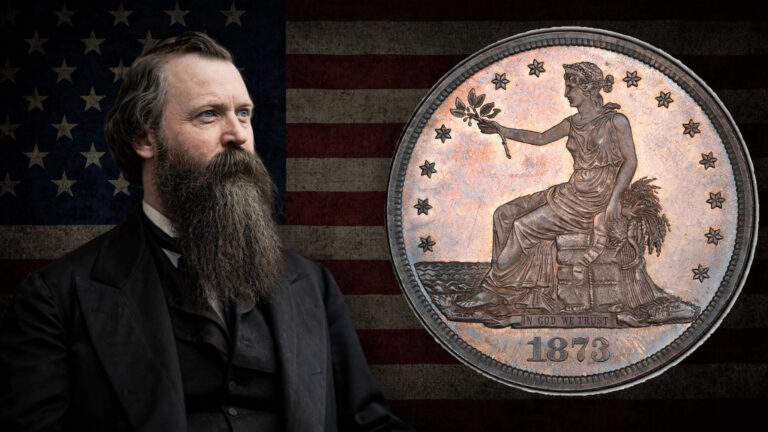
Who Was William M. Stewart, the Senator Who Branded 1873 a Crime?
William Morris Stewart (1827–1909) was Nevada's first senator, the mining lawyer known as the "Father of the Mining Laws of the United States" for the federal mining statutes of 1866 and 1872. His place in coin history is stranger. Stewart was in the Senate in 1873 and voted for the Coinage Act that ended the silver dollar — and then, after silver's price collapsed, he returned to the Senate in 1887 and spent eighteen years denouncing that act as the "Crime of '73," claiming its passage had been a deception. The voting record is the honest footnote to his legend: the man who made "crime" the act's permanent name had been one of its supporters.
Read More →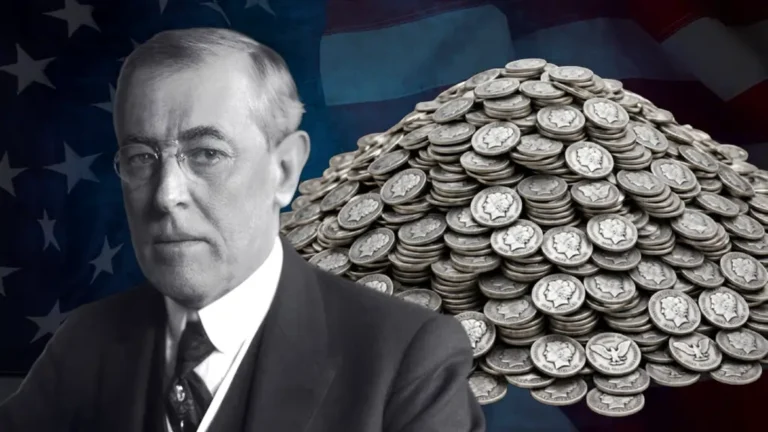
Why Did Woodrow Wilson Melt 270 Million Silver Dollars?
Woodrow Wilson signed the Pittman Act on April 23, 1918, a wartime measure that authorized melting up to 350 million silver dollars to supply Britain with bullion for India. In the end 270,232,722 silver dollars — nearly half of all ever struck — were melted, and the law's replacement clause is the direct reason the Morgan dollar returned in 1921 and the Peace dollar was born.
Read More →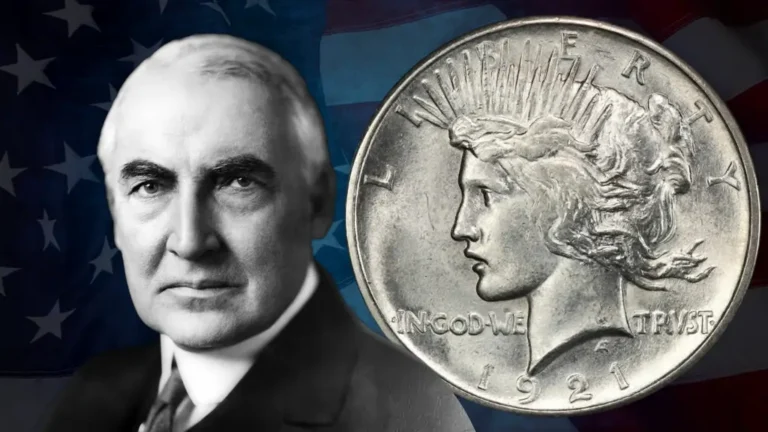
How Did Warren G. Harding Personally Shape the Peace Dollar?
Warren G. Harding shaped the Peace dollar with his own hand, unusually for a president. By Executive Order of July 28, 1921 he put coin designs under Commission of Fine Arts review, he personally approved Anthony de Francisci's winning drawings — objecting even to the dimple on Liberty's chin — and when veterans protested the broken sword on the reverse, he ordered it removed days before production began.
Read More →