


What Was the Coinage Act of 1792?
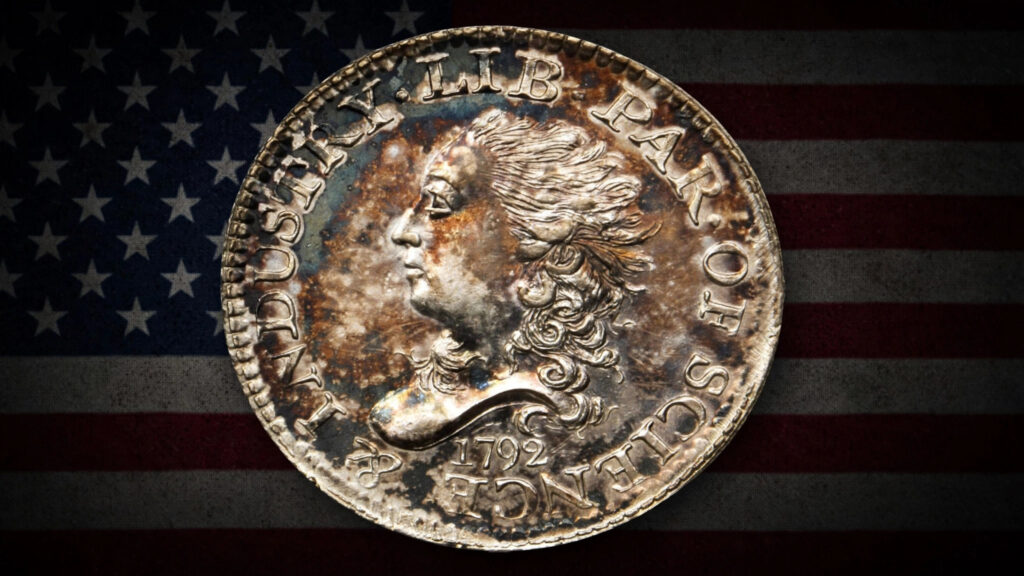
The Coinage Act of 1792 created American money: it established the dollar as the basic unit, divided into 100 cents; defined the dollar in silver with a 15-to-1 gold-to-silver ratio; created the United States Mint in Philadelphia; and authorized the first denominations, from the dollar down to the half cent. Before it, America had no national currency — only a chaotic mix of foreign coins, state issues, and private tokens.
Key Takeaways
- Before 1792, Americans used foreign coins, state issues, and private tokens valued by weight and metal.
- The act established the decimal dollar (100 cents) — radical when most nations used divisions like 12 pence to a shilling.
- It created the Mint and its officers: Director, Assayer, Chief Coiner, Engraver, and Treasurer.
- The Mint opened in 1792 and struck its first coins in 1793.
What money did America use before 1792?
When the United States won its independence, it had no national currency. Americans used a chaotic mix of foreign coins, state issues, and private tokens, valued by weight and metal content rather than by any national standard: Spanish dollars circulated alongside British shillings, French coins, and state and private issues, and every transaction required a calculation — what is this coin, what metal does it contain, and what is it worth in the goods being bought? The Constitution gave Congress the power to coin money and regulate its value, but it took the Coinage Act of 1792 to turn that power into a system. The act was the work of Alexander Hamilton, whose Report on the Establishment of a Mint laid out its principles: a decimal system, a bimetallic standard based on gold and silver, and a national mint to produce the coins.
What did the act create?
The act did several things at once, and each still shapes American money today. It established the dollar as the basic unit, divided into 100 cents — a decimal system that was radical at a time when most nations used awkward divisions, and that has been the American system ever since. It defined the dollar in terms of silver, establishing a silver dollar containing a specified weight of pure silver, with a gold-to-silver ratio of 15 to 1 — a bimetallic standard that governed American coinage for eighty years, whose tensions (the shifting market ratio versus the fixed legal ratio) drove much of 19th-century monetary politics. It created the United States Mint, to be built in Philadelphia, the nation's capital at the time, with its officers established by the act itself. And it authorized the first denominations: the dollar, half dollar, quarter, dime, half dime, cent, and half cent — a range reflecting an economy where a cent was meaningful money and a half cent was a usable coin. The act also set penalties for debasing or counterfeiting the new coinage — death, in the original text — a measure of how seriously the young republic took the integrity of its money; counterfeiting was not merely fraud but an attack on national sovereignty.
What happened in the Mint's first years?
The act created the Mint on paper; building it took longer. The Mint's first home was a small facility in Philadelphia, its equipment improvised, its staff tiny, and its first director, David Rittenhouse, was a scientist rather than a manufacturer. Its early years were a process of learning: how to refine metal, cut dies, strike coins consistently, and do it at a scale that could serve a growing nation. Those early struggles are visible in the coins themselves — uneven planchets, soft strikes, and die varieties that modern collectors study as diagnostics — but the Mint learned quickly. Within a few years it was striking silver dollars and gold coins, and within a decade it was producing coinage in quantities sufficient for the young republic's needs. Few pieces of legislation have lasted so completely: the dollar created by the act is still the dollar today, and the decimal system it established is still the system the entire country uses. For collectors, the Coinage Act of 1792 is the starting point — every American coin traces back to it: the denominations it authorized, the Mint it created, the dollar it defined, and the decimal system it established.
FAQ
What did America use for money before 1792? A mix of foreign coins, state issues, and private tokens, valued by weight and metal content.
Who wrote the Coinage Act of 1792? Alexander Hamilton, through his Report on the Establishment of a Mint.
Why is the decimal dollar significant? It replaced awkward divisions like 12 pence to a shilling with 100 cents to a dollar — simpler and still in use.
When did the Mint strike its first coins? In 1793: the Flowing Hair cents and half cents.
Shop early American coins at Coin Advisor or call (877) 540-2646.
This article was researched and drafted with AI assistance and reviewed and approved by Chris Clifton, Founder & CEO at Coin Advisor, before publication.
Shop NGC and PCGS certified coins at Coin Advisor
Shop Coins →Related Reading
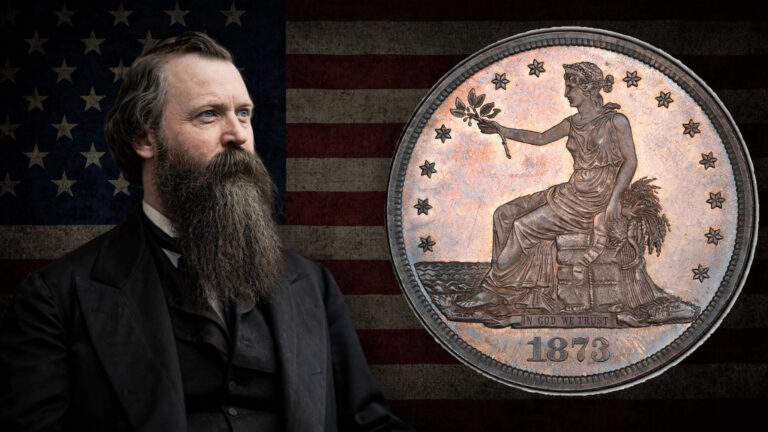
Who Was William M. Stewart, the Senator Who Branded 1873 a Crime?
William Morris Stewart (1827–1909) was Nevada's first senator, the mining lawyer known as the "Father of the Mining Laws of the United States" for the federal mining statutes of 1866 and 1872. His place in coin history is stranger. Stewart was in the Senate in 1873 and voted for the Coinage Act that ended the silver dollar — and then, after silver's price collapsed, he returned to the Senate in 1887 and spent eighteen years denouncing that act as the "Crime of '73," claiming its passage had been a deception. The voting record is the honest footnote to his legend: the man who made "crime" the act's permanent name had been one of its supporters.
Read More →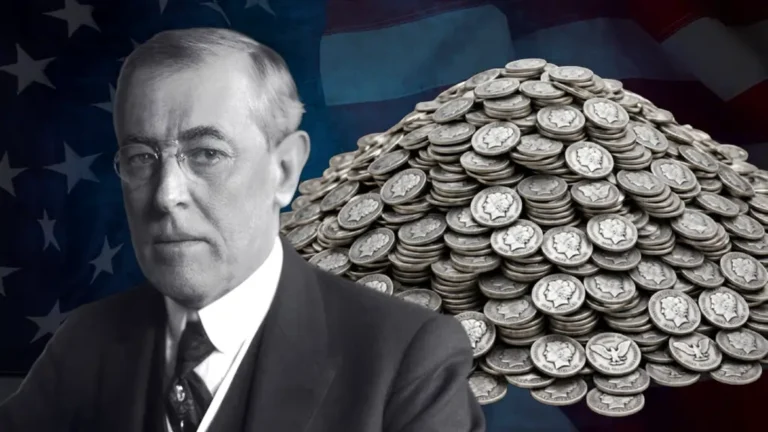
Why Did Woodrow Wilson Melt 270 Million Silver Dollars?
Woodrow Wilson signed the Pittman Act on April 23, 1918, a wartime measure that authorized melting up to 350 million silver dollars to supply Britain with bullion for India. In the end 270,232,722 silver dollars — nearly half of all ever struck — were melted, and the law's replacement clause is the direct reason the Morgan dollar returned in 1921 and the Peace dollar was born.
Read More →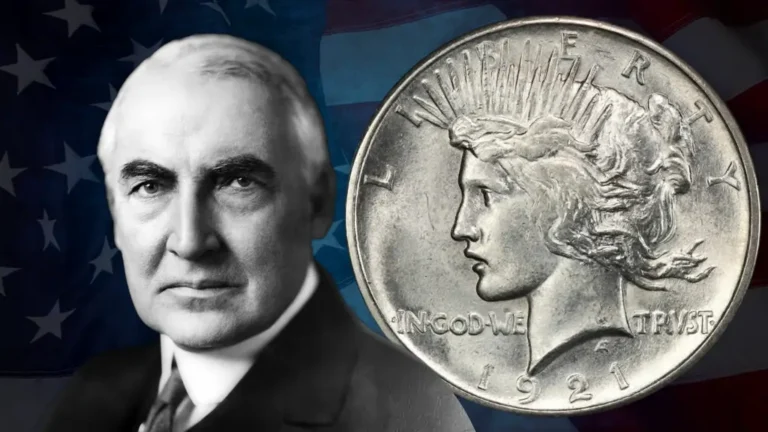
How Did Warren G. Harding Personally Shape the Peace Dollar?
Warren G. Harding shaped the Peace dollar with his own hand, unusually for a president. By Executive Order of July 28, 1921 he put coin designs under Commission of Fine Arts review, he personally approved Anthony de Francisci's winning drawings — objecting even to the dimple on Liberty's chin — and when veterans protested the broken sword on the reverse, he ordered it removed days before production began.
Read More →