


Why Are 1987 American Gold Eagles Dated MCMLXXXVII?

1987 American Gold Eagles are dated MCMLXXXVII because the young series wrote its dates in Roman numerals, as the Saint-Gaudens double eagle it revives had done. MCMLXXXVII is simply 1987 in Roman numerals. The Mint kept the format for the Gold Eagle’s first six years — MCMLXXXVI through MCMXCI, 1986 to 1991 — then switched to ordinary Arabic numerals in 1992 after the public complained the Roman dates were confusing. In that second bullion year, the one-ounce coin’s mintage was 1,045,500.
Key Takeaways
- MCMLXXXVII is one of the few early years the date was written in Roman numerals.
- Gold Eagles used Roman-numeral dates for their first six years, 1986–1991.
- The style honored the Saint-Gaudens double eagle design the series revives.
- Arabic numerals replaced them in 1992, after complaints the Roman dates confused buyers; the 1987 one-ounce bullion mintage was 1,045,500.
What does MCMLXXXVII mean?
It means 1987. Read in parts: M is 1,000, CM is 900, LXXX is 80, and VII is 7 — 1,987 in total. Every 1987-dated Gold Eagle, in all four bullion sizes and in proof, carries the date in this form, so a collector scanning the early series reads the years as MCMLXXXVI (1986), MCMLXXXVII (1987), and so on through MCMXCI (1991), after which the coins switch to the familiar Arabic style. Collectors of the early series learn the six dates quickly — MCMLXXXVI, MCMLXXXVII, MCMLXXXVIII, MCMLXXXIX, MCMXC, MCMXCI — because the Roman format is the quickest attribution in the program: Roman numerals on a Gold Eagle mean 1986 to 1991.
Why did the Mint use Roman numerals at all?
As a tribute built into the design. The Gold Eagle’s obverse revives Augustus Saint-Gaudens’ double eagle of 1907–1933, widely considered the most beautiful U.S. coin design, and the original Saint-Gaudens coins opened their run with a Roman-numeral date. Giving the new bullion coin a Roman-numeral date tied it visibly to that heritage. For the program’s first years the Mint treated the date as part of the artwork rather than as data — classical lettering suits a design adapted from 1907. The experiment lasted six years: in 1992 the Mint moved to Arabic numerals, responding to public complaints that the Roman dates were confusing. Buyer confusion — the practical objection that people could not quickly read the year — is what ended it, and the change now gives collectors a clean dividing line between the early and later bullion issues.
| One-ounce bullion Gold Eagle | Date style | Mintage |
|---|---|---|
| 1986 | MCMLXXXVI (Roman) | 1,362,650 |
| 1987 | MCMLXXXVII (Roman) | 1,045,500 |
How did the 1987 bullion Gold Eagles sell?
Solidly, if below the debut year’s pace. The one-ounce coin — the size that anchors the bullion program — was struck to 1,045,500 pieces in 1987, against 1,362,650 in the 1986 launch year. A second-year step down from a heavily promoted debut is the normal pattern for a new bullion program, and the fractional sizes shared in the year at their own scales; the one-ounce figure is the one tracked as the headline because the one-ounce coin is the bullion market’s unit of account for the series. The four-size Gold Eagle family, in production since the 1986 launch, settled into the annual rhythm it has kept ever since.
Shop American Gold Eagles and other certified U.S. gold coins at Coin Advisor or call (877) 540-2646 to talk with an advisor about the Roman-numeral issues.
FAQ
What year is MCMLXXXVII? 1987: M (1,000) + CM (900) + LXXX (80) + VII (7).
How long did Gold Eagles use Roman-numeral dates? Six years — 1986 through 1991, MCMLXXXVI through MCMXCI.
Why did the Mint stop using Roman numerals? The public found them confusing. The Mint switched Gold Eagles to Arabic numerals in 1992 in response to the complaints.
How many one-ounce bullion Gold Eagles were struck in 1987? 1,045,500 — the second-year total, against 1,362,650 in the 1986 debut year.
This article was researched and drafted with AI assistance and reviewed and approved by [Author], [Role] at Coin Advisor, before publication.
Shop NGC and PCGS certified coins at Coin Advisor
Shop Coins →Related Reading
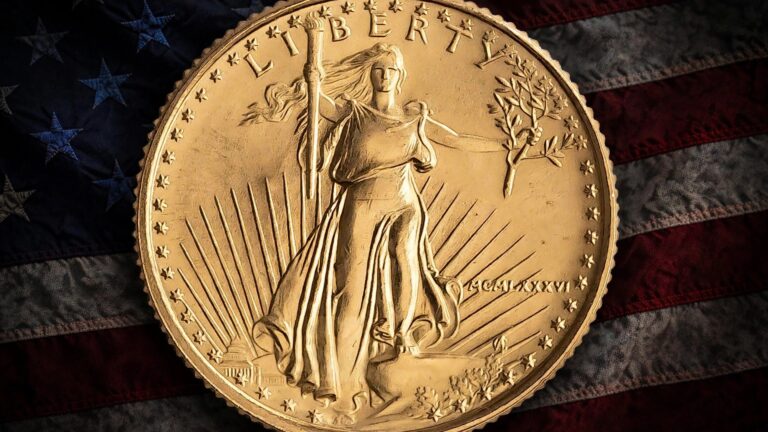
What Were the First American Gold Eagle Bullion Coins?
The first American Gold Eagle bullion coins were released on October 20, 1986, under the Gold Bullion Coin Act of 1985. They were the first gold bullion coins the United States Mint had ever issued, and they ended a gap of more than fifty years in American gold coinage: no U.S. gold coins had been struck since the early 1930s. For the design, the Mint reached back to the most admired gold coin in its history — Augustus Saint-Gaudens' double-eagle Liberty, created for the $20 gold piece of 1907. The one-ounce bullion coin's first-year mintage was 1,362,650 pieces.
Read More →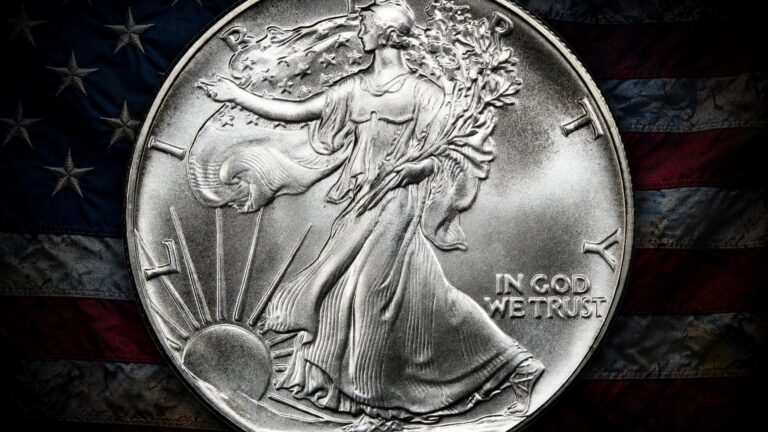
What Was the First American Silver Eagle Bullion Coin?
The first American Silver Eagle bullion coin reached the public on November 24, 1986 — a one-ounce silver bullion coin authorized by the Liberty Coin Act and struck from silver held in the Defense National Stockpile. The program began with a ceremony: Treasury Secretary James Baker struck the first coin at the San Francisco Mint on October 29, 1986. The first-year mintage of 5,393,005 coins sold out almost immediately. The coin pairs Adolph A. Weinman's Walking Liberty with John Mercanti's heraldic eagle, two designs that have defined the series ever since.
Read More →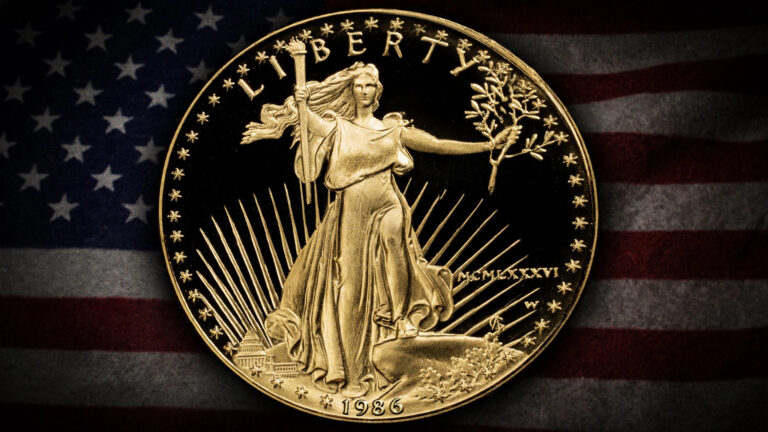
What Is the 1986-W Proof American Gold Eagle?
The 1986-W Proof American Gold Eagle is the one-ounce proof struck at West Point in the Gold Eagle program's debut year — and it was the only proof Gold Eagle offered in 1986. Where the bullion program launched in four sizes at once, the proof lineup began with a single coin. Its mintage of 446,290 remains the highest ever recorded for a proof Gold Eagle of any year or size, a record set in the program's first months and never since approached.
Read More →